
From Owning Projects to Co-Owning Outcomes
Partnerships, Public Systems and the Architecture of Co-Ownership
Key insight
A field note on why partnerships fail when everyone owns projects, and begin to work when people co-own outcomes.
Linked summit sessions
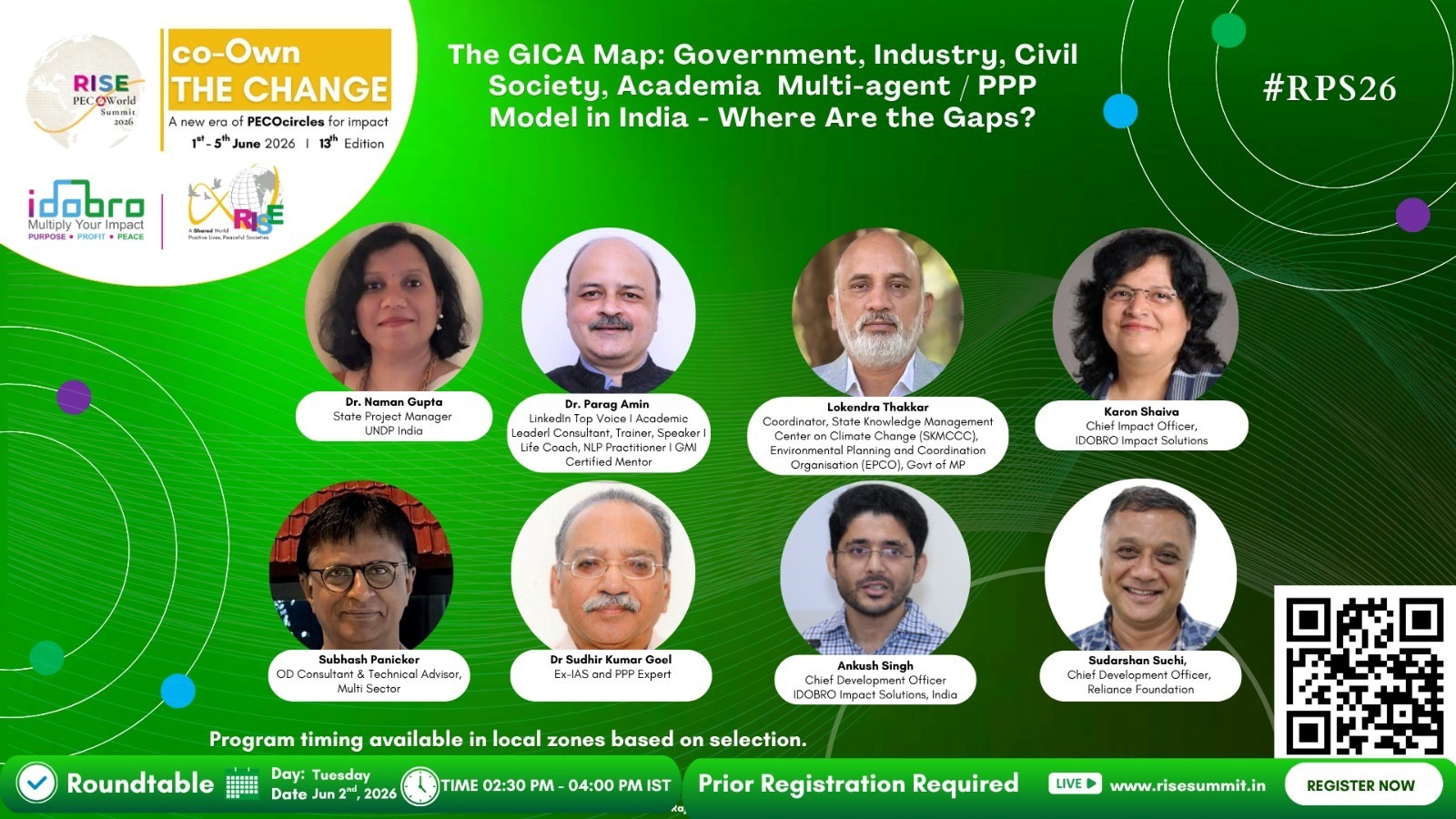
One of the clearest insights from the partnership roundtable was that ecosystems do not fail because there are too few actors. They often fail because there are too many disconnected actors, each measuring their own activity and defending their own boundary. The transcript returned again and again to this image of scattered dots: government, industry, civil society, academia, community organizations, funders and local leaders all working, but not necessarily adding up to change.
The problem is not the absence of leadership. In many development fields, every dot is a leader in its own domain. The difficulty begins when all leaders need to recognize a coordinating logic larger than their own mandate. A conventional project mindset asks, what did my organization deliver? An ecosystem mindset asks, what changed because the system worked better? This distinction matters because many monitoring systems still reward visible activities: trainings conducted, funds spent, reports submitted, people reached. These are useful indicators, but they do not prove that the whole field has moved.
The discussion placed special emphasis on agriculture, climate action, last-mile delivery and public-private partnerships. These are fields where no single organization can claim complete ownership. Farmers, local communities, regulators, businesses, technical institutions and civil society actors all hold part of the truth. Yet the knowledge of smaller local organizations is often underweighted because they do not carry the brand power of larger institutions. The transcript named this as a real pattern: field actors may have lived insight, but support tends to flow toward those with visibility, scale and familiarity.
A better partnership architecture starts by shifting from control to contribution. Partners do not need to own the whole outcome. They need to be clear about which part of the outcome they can strengthen, and where they need others. This is the logic behind co-ownership. It does not erase accountability. It distributes accountability across people who are honest about their role in the system. It also allows partnerships to be more adaptive. If the field changes, the partnership can reconfigure because its purpose is not to protect a project design, but to protect the outcome.
The session also pointed to a second challenge: measurement. If each partner measures only what it directly did, the ecosystem remains invisible. The platform needs ways to record contribution, trust, referrals, shared learning, field validation and community uptake. These are harder to count than events or trainings, but without them, partnerships remain transactional.
For PECOWorld, the implication is direct. The Passport, GOTO Exchange, PECONet and PECOCircle are not separate features. They are a pathway from identity to contribution to group formation to co-owned action. A participant declares a cause, community and county. A contributor posts a Give or Take. A member joins a PECONet. A collaborator helps anchor a PECOCircle. The journey matters because it turns attendance into accountable participation.
The article-worthy takeaway is simple: the future of partnerships is not bigger coordination meetings. It is sharper clarity on who contributes what, who is affected, what outcome is being protected, and how smaller actors with lived knowledge are made visible in the architecture of change.