
Start With the Who: Complexity as a Practice
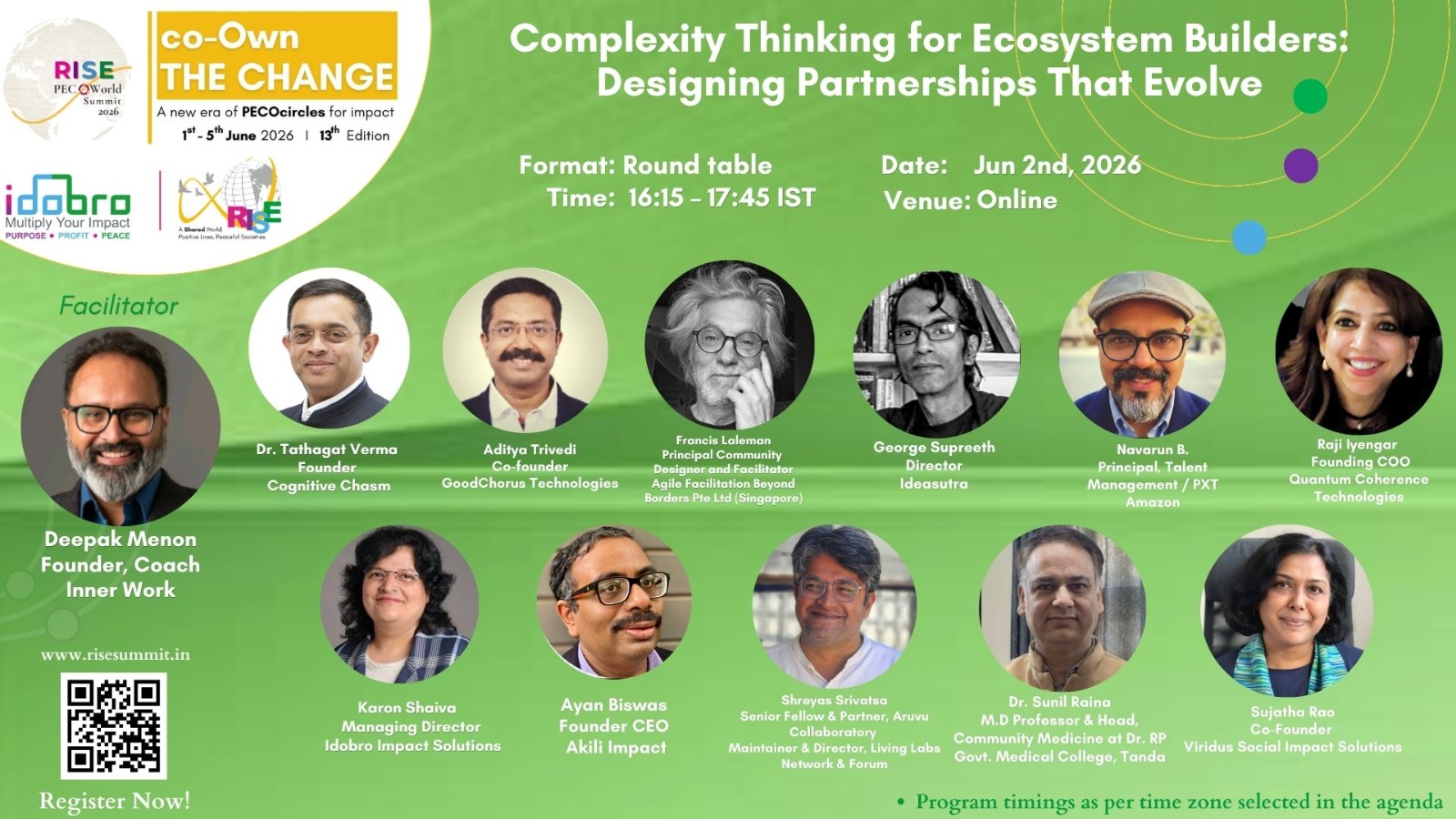
Complexity Thinking for Ecosystem Building
Key insight
A practical reading of complexity thinking for youth, institutions and ecosystem builders working in fast-changing environments.
Linked summit sessions
The complexity session began with a useful discomfort. Many people have been educated to think in straight lines: choose a path, follow a curriculum, earn a qualification, secure a job, progress toward a defined goal. But the world that young people and institutions now face does not behave in straight lines. Political shocks, climate events, AI, migration, ecological stress and social fragmentation keep changing the field while people are still planning for it. The session invited participants to see their future not as a fixed ladder, but as a complex adaptive system.
A complex adaptive system is not merely complicated. A complicated problem may have many parts, but it can still be solved by expertise, sequencing and control. A complex problem changes as people interact with it. Boundaries are unclear. Actors interpret reality differently. Feedback loops emerge. A decision that helps in one part of the system may create risk elsewhere. This is why ecosystem work often feels confusing at first. Each partner enters with what they know, but every partner has a different map of what matters.
The transcript offered a powerful description of this early phase. People categorize the system from their own vantage point. Some elements feel familiar, so they become visible. Others remain tacit, sensed but not named. The boundaries within which each actor operates may be unknowable at the beginning. Everyone starts from their known piece, and the ecosystem becomes a dance of partial knowledge. This is not a failure. It is the normal starting point of complexity.
The practical question is how to act without pretending to know everything. One answer was to begin with sense-making before solution-making. Instead of rushing to impose a project frame, actors need to ask what patterns are emerging, who is affected, who is deciding, who is missing and what assumptions are shaping action. This is where the session challenged the popular advice to start with why. In complex systems, it may be more useful to start with who. Who is taking decisions? Who is taking action? Who is affected by those actions? Who carries risk without voice? Who has knowledge that is not yet recognized?
This shift from why to who matters because complexity is lived by people before it is analyzed by institutions. A community facing flood, drought, health insecurity or livelihood loss does not experience complexity as a theory. It experiences it as overlapping pressures. If ecosystem builders do not locate the people inside the system, they may design elegant interventions that miss the real distribution of power, cost and consequence.
For PECOWorld, complexity thinking strengthens the case for the three Cs: Cause, Community and County. A cause names the field of concern. A community names the people and relationships through which trust moves. A county or area of operation grounds the work in place. Together, they stop ecosystem building from becoming abstract. They make complexity navigable without reducing it to a simple checklist.
The session leaves one discipline for platform users: do not seek certainty before beginning, but do not begin blindly. Start by naming who is involved, who is missing, what each actor sees, and what outcome is worth co-owning. Complexity then becomes less a barrier and more a practice of listening, adapting and acting with humility.