
Collaborating with the Government- the skill social enterprises don't understand fully
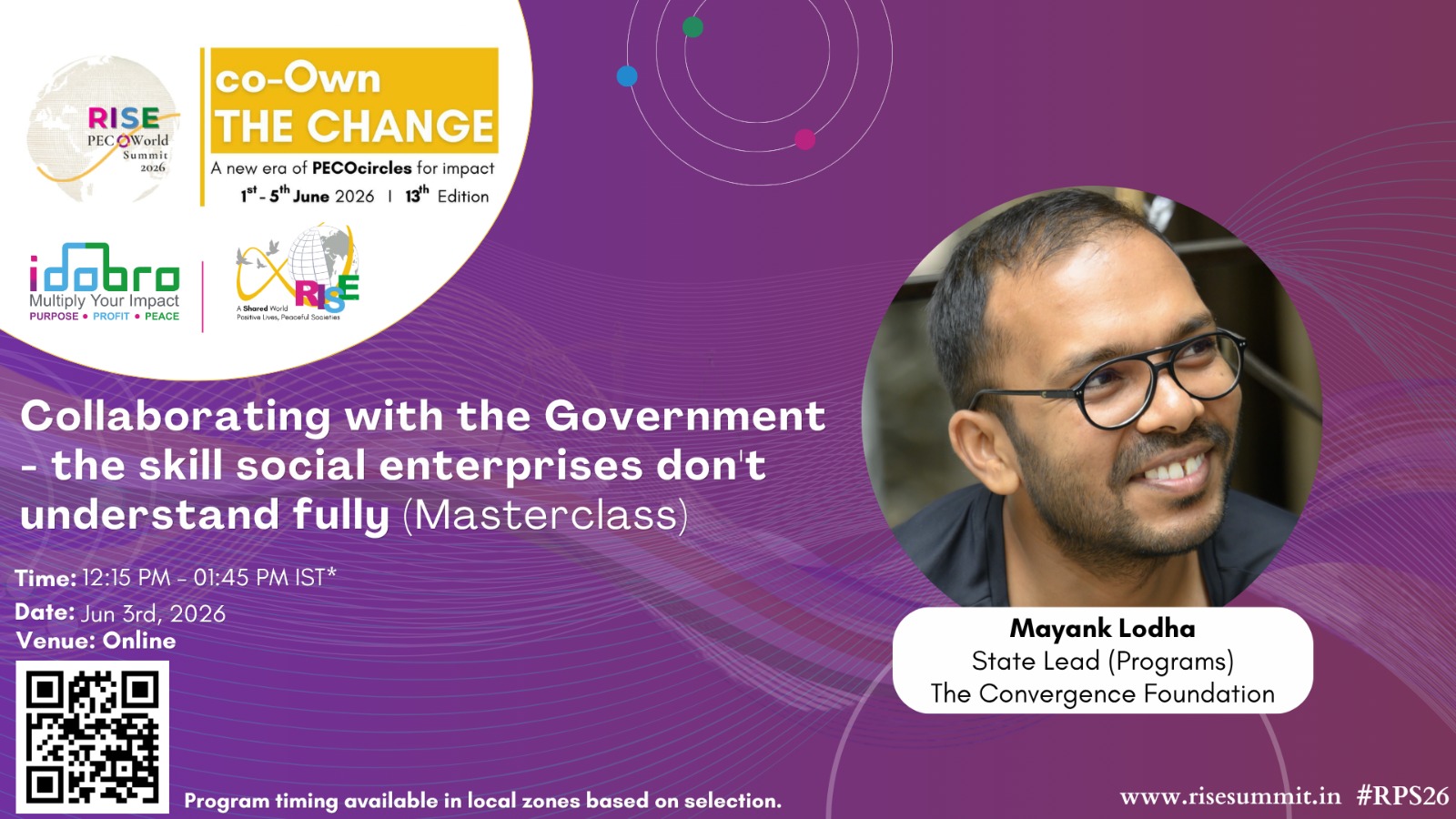
Social enterprises frequently stall by treating the state as a mere funding tap or a rigid adversary. Mayank Lodha (State Lead at The Convergence Foundation), in this session held on June 3rd 2026, argues that real systemic scale requires positioning innovations as structural assets that directly serve the state's existing mandates. The core thesis: sustainable public sector collaboration is a long-term operational marathon, requiring innovators to move from an outside "selling" pitch to an inside "mandate-alignment" strategy. A crisp, data-backed briefing note delivered directly to an administrative secretary preserves institutional legacy far better than a flashy, high-tech boardroom presentation. In the social impact space, we face a recurring operational paradox: innovators design brilliant grassroots solutions but treat the scale engine—the government—as an obstacle to bypass or an ATM to pitch. For decades, engagement has been treated as a series of short-term transactions rather than a deep structural integration. This adversarial or extractive framing has consequences, leaving high-potential models stranded in pilot purgatory. To break this stagnation, Mayank Lodha argues that social enterprises must pivot from viewing the state as a critic to recognizing the executive branch as their primary partner on a national scale. Navigating the Executive Engine: A Marathon of Trust The government is a massive, multifaceted monolith encompassing the legislature, judiciary, and executive branches. For social enterprises looking to scale an operational solution, Lodha highlights that the real focus must narrow exclusively to the executive branch—the machinery responsible for policy implementation. True collaboration within this sphere is a marathon, not a sprint. The rigid hierarchies of civil service demand deep institutional patience and a multi-year commitment to trust-building. Credibility in the eyes of state actors is built through consistent, reliable execution on the ground, not through polished initial pitch decks. In the public ecosystem, your long-term presence is your actual proof of concept. The Art of the Bureaucratic Pivot: Aligning with Mandates The standard private-sector sales pitch fails entirely when applied to state systems. Rather than trying to "sell" a shiny, standalone external product, Lodha notes that social enterprises must entirely reframe their approach to ask a fundamental question: “What does the government need that I can help with?” Bureaucrats are risk-averse by design; their careers are structured around public accountability and compliance. To mitigate their perceived risk, solutions must be deliberately engineered to slot directly into existing scheme budgets, guidelines, and pre-established Key Performance Indicators (KPIs). The Operational Blueprint: Paperwork as Institutional Memory One of the greatest hazards in government collaboration is the frequent transfer of personnel. A champion bureaucrat who backs your project today could be reassigned tomorrow. To survive this volatility, social enterprises must master the mechanics of bureaucratic paperwork to build what Lodha calls an "institutional legacy." Creating an official, meticulous paper trail ensures your project builds a memory that outlasts any single individual's tenure. Enterprises must learn to communicate through crisp, highly specific briefing notes that outline the clear context, value proposition, empirical evidence, and explicit administrative "asks." Furthermore, navigating this ecosystem requires deep respect for the human element: building genuine rapport with the administrative staff, personal assistants, and secretaries who actively control access to ultimate decision-makers. System Over Jolts: Protecting the Last Mile A brilliant model will collapse instantly if it creates a system shock. If an enterprise introduces a workflow that drastically increases the daily burden on already overwhelmed frontline field staff, the project is dead on arrival. The goal must always be to optimize and smooth efficiency within the state's existing field capacities. Beyond simple operational adjustments, social enterprises carry a profound moral imperative. They act as the vital bridge that injects real citizen voices directly into cold bureaucratic processes, ensuring that massive, top-down state programs remain responsive to actual human needs. Conclusion: Scale Meets Innovation The future of large-scale social impact depends entirely on bridging the gap between flexible, innovative grassroots models and the government's unparalleled capacity for scale. True success lies in shifting the paradigm entirely: the social enterprise is no longer an external vendor or a noisy critic, but a co-architect of public delivery. The masterclass closes on a critical question for modern social changemakers: Are you ready to stop pitching to the government, and start solving with it? FAQ Why should social enterprises focus primarily on the executive branch? While the legislature creates laws and the judiciary interprets them, the executive branch is the sole arm responsible for ground-level policy implementation. If your goal is operational scale, the executive branch is the machinery that owns the delivery network. How do you prevent a collaboration from collapsing when a key government official gets transferred? By prioritizing a continuous, official paper trail over verbal agreements. Documenting every milestone, approval, and guideline alignment establishes an institutional legacy, ensuring the project becomes embedded within the department's memory rather than a single official's office. What does it mean to avoid "jolting" the government system? It means designing interventions that do not overload the capacity of already constrained frontline workers. A successful solution must smoothly integrate into the existing operational workflows of field staff, enhancing their efficiency rather than expanding their workload.
Watch again